Investing
Portfolio Rebalancing: What It Is and How to Automate It
Education, not financial advice. This page may contain affiliate links: if you buy through one, Alpha Investing Group may earn a commission at no extra cost to you. How we earn money · Editorial policy
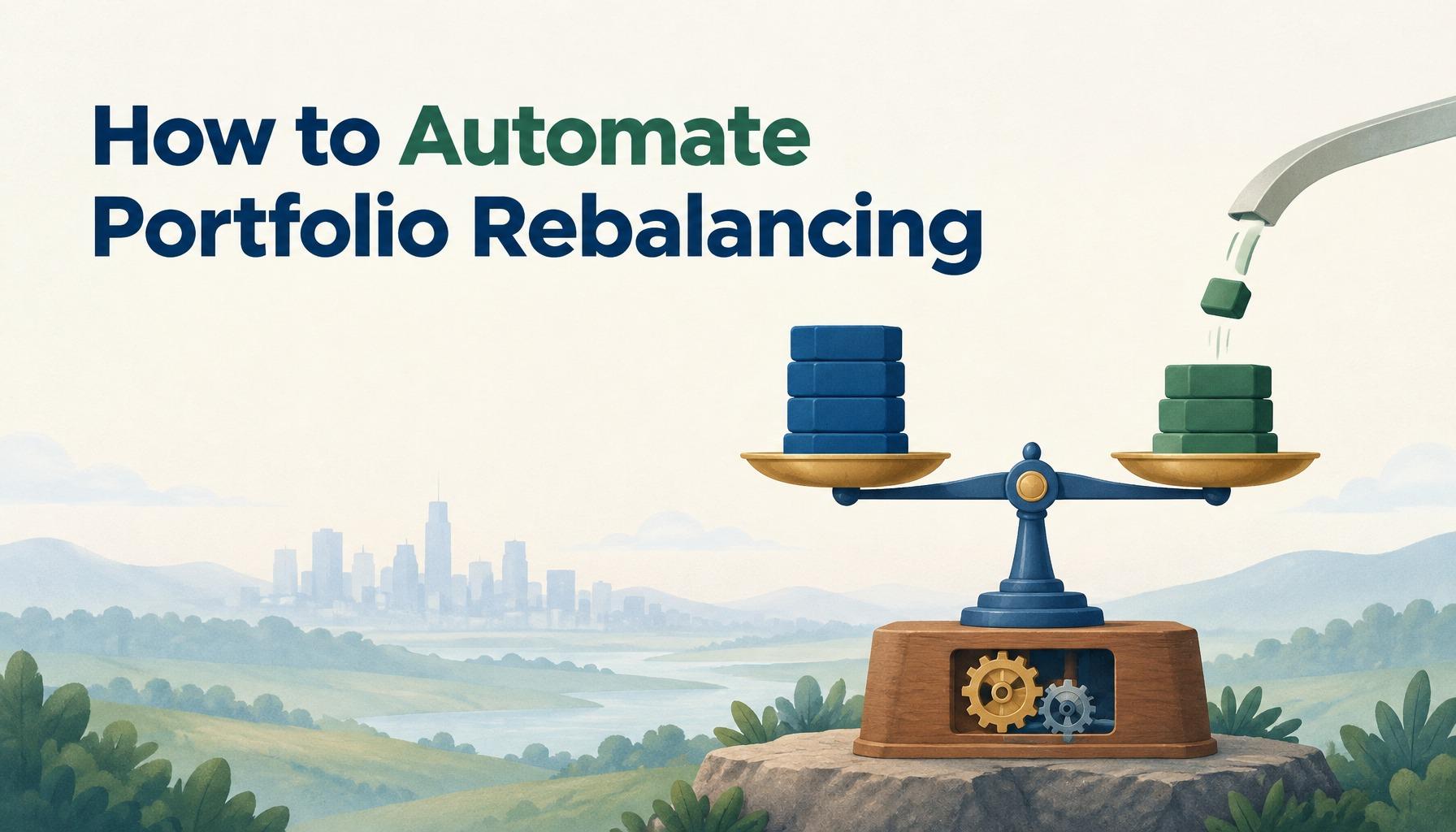
Portfolio rebalancing means selling some of what has grown and buying more of what has lagged, so your investments get back to the mix you chose. If you planned on 80% stocks and 20% bonds and a few strong years for stocks left you at 87/13, rebalancing moves you back to 80/20.
The point is to keep your risk where you set it, not to squeeze out extra return. Vanguard's researchers put it plainly in their paper on best practices for portfolio rebalancing: the primary goal "is to minimize risk relative to a target asset allocation, rather than to maximize returns."
Most people never get around to doing it by hand. In workplace plans run by Vanguard, 95% of participants who didn't use a managed account made no trades at all in 2025, according to Vanguard's How America Saves 2026 report. That's why this guide starts with automatic rebalancing: the funds, services and 401(k) settings that do it for you. It's general education, not personal advice.
What is allocation drift?
Allocation drift is what happens to your mix when you leave it alone. Stocks and bonds earn different returns, so their shares of your portfolio change. FINRA's report on digital investment advice says drift occurs "when the constituent securities in a portfolio perform differently, which can lead to over or under weighting asset classes."
It happens faster than most beginners expect. I took a hypothetical $10,000 split 80/20 at the start of 2019. The stock side earned the S&P 500's actual total return each year and the bond side earned the 10-year US Treasury bond's, using NYU Stern professor Aswath Damodaran's historical returns data. Then nobody touched it.
Stock share of an 80/20 portfolio left alone, 2019 to 2025
On actual S&P 500 and 10-year Treasury returns, a hypothetical 80/20 portfolio that was never rebalanced reached 92% stocks by the end of 2025.
- Target: 80% stocks
Source: Alpha Investing Group calculation on Aswath Damodaran's historical returns (NYU Stern): S&P 500 total return and 10-year US Treasury bond return. Hypothetical $10,000 start, no fees, taxes or new money. · Alpha Investing Group
Show the data
| Year end | Share of the portfolio in stocks |
|---|---|
| Start of 2019 | 80% |
| 2019 | 82.7% |
| 2020 | 83.5% |
| 2021 | 87.2% |
| 2022 | 87.2% |
| 2023 | 89.2% |
| 2024 | 91.3% |
| 2025 | 92% |
By the end of 2025, that 80/20 portfolio was 92% stocks. The S&P 500 returned more than 17% in six of those seven years, and the stock side ran away with the portfolio.
Look at 2022, though. Stocks and bonds both fell about 18%, so the mix barely moved. What drives drift is the gap between the two returns, and the direction of the market hardly matters.
Over longer stretches it gets bigger. In Vanguard's Rational rebalancing paper, a 60/40 portfolio left alone from the end of 1989 had 80% in stocks by the end of 2021.
Why rebalance? Risk control, not higher returns
A portfolio that drifts toward stocks takes on more risk than you signed up for. Vanguard's test of a 60/40 portfolio from 1926 to 2009, in the same best-practices paper, shows the trade-off:
- Rebalanced once a year, it averaged an 8.6% annual return, with a standard deviation (a measure of how much returns swing) of 11.9%.
- Never rebalanced, it drifted to an average of more than 84% stocks and averaged 9.1% a year, with a standard deviation of 14.4%.
- Rebalancing every month instead of every year made almost no difference: 8.5% and 12.1%.
So yes, the portfolio nobody touched earned a little more. It did that by quietly turning into a different, riskier portfolio. If you're 25 with a 90% stock target, drifting to 95% isn't a disaster. If you need the money in five years, it can be. Choosing that target is the bigger decision, and our guide to asset allocation by age walks through it.
A caveat before the options. If your whole account sits in one fund, there's nothing for you to rebalance. It only matters once you hold two or more things that move differently, like stocks and bonds, or US and international stocks (a split we cover in whole-world or US-only index funds).
Automatic rebalancing: four ways to put it on autopilot
Automatic portfolio rebalancing comes in four main forms, and if you have a 401(k), you may already be using one.
Target-date and all-in-one funds
A target-date fund holds a mix of stock and bond funds and keeps that mix on track for you. The SEC's investor bulletin on target date funds explains that, unlike other funds, they "rebalance or change the fund's mix of investments over time," moving from mostly stocks toward more bonds as the target year gets closer. That slow shift is called the glide path.
How often the fund trades depends on the manager. Vanguard's research paper on its own target-date funds, The rebalancing edge, describes checking the mix every day and rebalancing once it drifts 2 percentage points from target. The federal Thrift Savings Plan rebalances its L Funds at the end of every trading day.
All-in-one balanced funds work the same way but hold one fixed mix, such as 60/40, that doesn't change as you age.
These funds are the default for a lot of people. In 2025, 61% of participants in Vanguard-run plans had their entire account in a single target-date fund. The catch the SEC flags is fees. A target-date fund usually invests in other funds, so you can pay at both levels, which makes it worth comparing its expense ratio against the lowest-cost index funds.
Robo-advisers
A robo-adviser is an automated investing service that builds a portfolio from your answers to a questionnaire and then manages it. The services FINRA reviewed rebalanced in different ways. One used "a bright line threshold of 3 percent portfolio drift" and checked every day, while others rebalanced periodically without publishing a number. A robo-adviser can also use your deposits and dividends to buy whatever is underweight before it sells anything.
You pay for this with a yearly advisory fee, on top of the expense ratios of the funds it buys for you, usually ETFs. Before you sign up, find out what triggers a rebalance, how often it trades and whether it sells in a taxable account. FINRA suggests asking exactly those questions.
Your 401(k)'s automatic rebalancing setting
If you picked your own funds in a workplace plan, look for an automatic rebalancing option on the plan's website. Where it's offered, you choose a schedule and the plan resets your balances to your chosen percentages. A guide to auto-rebalancing for 401(k) participants, published by Paychex and written by the adviser Mesirow, describes setting it "to quarterly or even annually, through a participant web site."
Not every plan has it, so check your plan's investment settings or ask your HR team. And because the trades happen inside the 401(k), they don't create a tax bill.
Rebalancing with new money
This is the do-it-yourself version that comes closest to automatic. Instead of selling, you send new contributions, and dividends if you can, to whichever side is underweight until the mix is back on target. The SEC's beginners' guide to asset allocation and rebalancing lists this as one of three ways to rebalance.
Vanguard found that simply redirecting a portfolio's income "would have achieved most of the risk-control benefits" of busier strategies at much lower cost. It works best while you're still adding money and the drift is small. A big gap can need more new money than you have.
Automatic rebalancing options compared
| Option | Who it suits | Cost | Effort | Tax impact |
|---|---|---|---|---|
| Target-date fund | Retirement savers who want one fund and no decisions | The fund's expense ratio, which can cover several underlying funds | Pick it once | You never sell to rebalance |
| All-in-one balanced fund | Anyone happy with one fixed mix, such as 60/40 | The fund's expense ratio | Pick it once | You never sell to rebalance |
| Robo-adviser | People who want a managed mix of ETFs, including in a taxable account | Advisory fee plus fund expense ratios | Set up once | Can sell winners in a taxable account |
| 401(k) auto-rebalance setting | Plan members who chose their own funds | Your plan's usual fund and plan fees | Turn it on once | None inside the plan |
| Rebalance with new money | Regular savers who don't mind a yearly check | Nothing extra | A few minutes a year | None, because nothing is sold |
When to rebalance if you do it yourself
If you hold a few funds of your own, you need a rule for when to act. Most people use one of these three:
- A calendar rule, where you pick a date and reset once or twice a year. The SEC's guide says many experts suggest "every six or twelve months."
- A threshold rule, where you rebalance whenever part of your mix drifts a set amount, such as 5 percentage points (80% stocks becoming 85%). It's precise, but you have to keep watching.
- A mix of the two, where you check on a schedule and act only if the drift has passed your threshold.
Vanguard's research says the choice matters less than people think. Its best-practices paper found "no optimal frequency or threshold," because risk-adjusted returns barely differed between monthly, quarterly and yearly rebalancing. Costs did differ. Checking monthly with a 1% threshold meant 389 rebalancing trades over the period, against 15 for a yearly check with a 10% threshold. Its conclusion was that checking once or twice a year and rebalancing at 5% thresholds strikes a reasonable balance for most investors, and yearly is better when taxes are involved.
The newer Rational rebalancing paper landed in a similar place. The best methods were "neither too frequent, such as monthly or quarterly calendar-based methods, nor too infrequent, such as rebalancing every two years," and annual rebalancing came out best for investors who don't harvest tax losses.
My take: pick one date a year you'll actually remember, like your birthday, and only act if you're 5 or more points off.
A worked example
This one is illustrative, built on the same real index returns as the chart. Say you put $10,000 into an 80/20 mix at the start of 2023. By the end of 2025, the stocks had grown to about $14,826 and the bonds to about $2,203, for a total of $17,029. That's 87% stocks, 7 points over target and past a 5-point threshold.
There are two ways back to 80/20:
- Sell about $1,203 of stocks and buy $1,203 of bonds. You end up with $13,623 in stocks and $3,406 in bonds.
- Put the next $1,504 you invest entirely into bonds. At $300 a month, that's about five months of contributions, and nothing gets sold.
These figures ignore fees and taxes, and past returns don't tell you what the next three years will do.
How to rebalance without a big tax bill
Rebalancing only costs you tax when you sell at a profit in a taxable account, so most of the fix is about where you do it:
- Do your selling inside a 401(k) or IRA first. Trades inside those accounts don't trigger capital gains tax when you make them.
- In a regular brokerage account, selling a fund for more than you paid is a capital gain. The IRS explains capital gains as long-term if you held the investment for more than a year, and long-term gains can be taxed at a lower rate than your ordinary income.
- Use new money and dividends before you sell anything, and sell only the amount you need.
- Treat all your accounts as one portfolio. If your bonds sit in your 401(k), you can rebalance there and leave a taxable account alone. Our guide to tax-efficient investing covers where to hold what.
The short version
Drift is normal, and it's sneaky. An untouched 80/20 portfolio became 92/8 in seven years without anyone making a single decision.
The easiest fix is to let something else do the work: a target-date or all-in-one fund, a robo-adviser, or your 401(k)'s rebalancing setting. If you'd rather run it yourself, the routine is short:
- Write down your target mix.
- Check it once a year on the same date.
- Act only if something is 5 or more points off, using new money first.
- Sell inside tax-advantaged accounts before taxable ones.
I'd rather you spend those few minutes a year on this than any time at all guessing where the market goes next.